How Travel Creators Can Monetize Their Knowledge
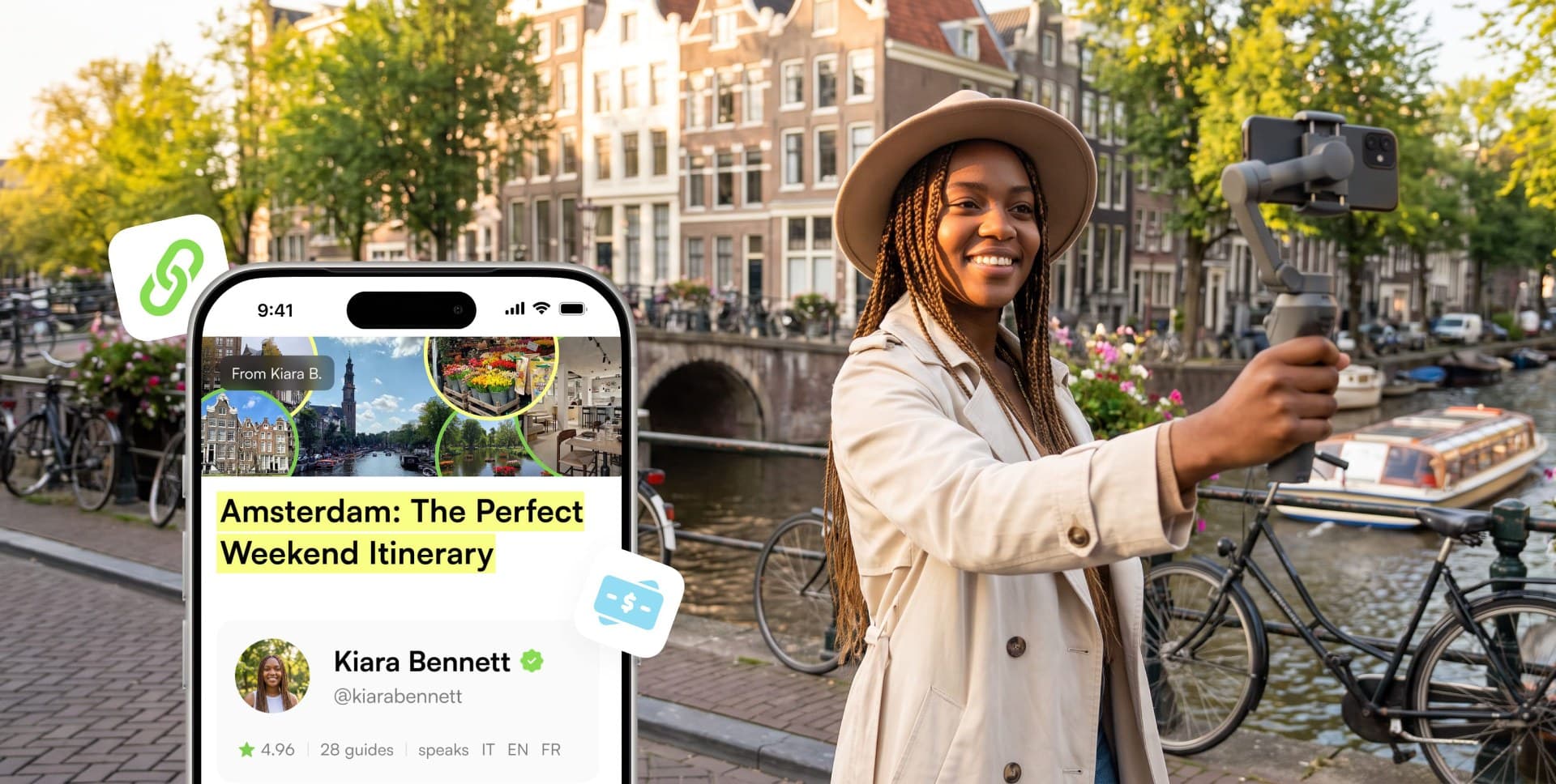
Every travel creator has something valuable to offer.
This could be years of exploring destinations, carefully planned itineraries, local recommendations, hidden cafés or practical tips that make travelling easier. Whenever someone asks for recommendations on where to stay, what to see or how to spend a weekend in a new city, they're asking for the knowledge that you've already acquired.
Many creators already earn money through sponsorships, affiliate marketing, tours or travel planning services. While these are all valuable income streams, most of them rely on one thing: your continued time and effort.
The challenge isn't finding ways to make money. It's building a business that doesn't depend on constantly creating new content or working with clients individually.
The most successful travel creators rarely rely on a single source of income. Instead, they combine multiple revenue streams to create a business that's more stable, scalable and resilient.
In this guide, we'll explore the most common ways in which travel creators monetise their knowledge, explain how different income streams can work together, and demonstrate why developing your own digital products can be an important component of a sustainable creator business.
Build a Business, Not Just an Income
Sponsored campaigns, private itineraries and guided tours can all be highly lucrative. The problem isn't that these opportunities are ineffective — they are. The challenge is that they all require your time. Every new booking requires another tour, consultation or piece of content. Consequently, your income is directly tied to the hours you can work, which makes it difficult to build something that continues to earn money even when you're offline.
If you don't publish another sponsored post, you won't receive another payment. If you stop offering private planning sessions, new bookings will stop too. Even guided tours are limited by your availability and the number of travellers you can serve personally.
This is why many experienced travel creators gradually shift their focus from relying on a single source of income to building a business with multiple revenue streams.
Instead of asking, "What's the fastest way to make money?", they ask a different question:
"How can I create a business that continues generating value—and income—even when I'm not working with the client at a time?"
This change of mindset is often what transforms a side project into a sustainable travel business.
Before deciding which income streams are right for you, it's helpful to understand the difference between earning money by selling your time and earning money from assets you've already created.
Active Income vs. Scalable Income
Not all income streams work in the same way.
Some require you to invest time with every sale. Others allow you to continue earning from work you have already completed.
Neither approach is inherently better. Active income can be highly profitable and often helps you to build stronger relationships with your audience. However, it's limited by one simple factor: your time.
Scalable income works differently. Although it typically requires an initial investment of time and effort, it can generate revenue continuously without needing to be recreated for each customer.
The most successful creator businesses don't rely exclusively on one model. Instead, they combine active and scalable income streams to create a more balanced and resilient business.
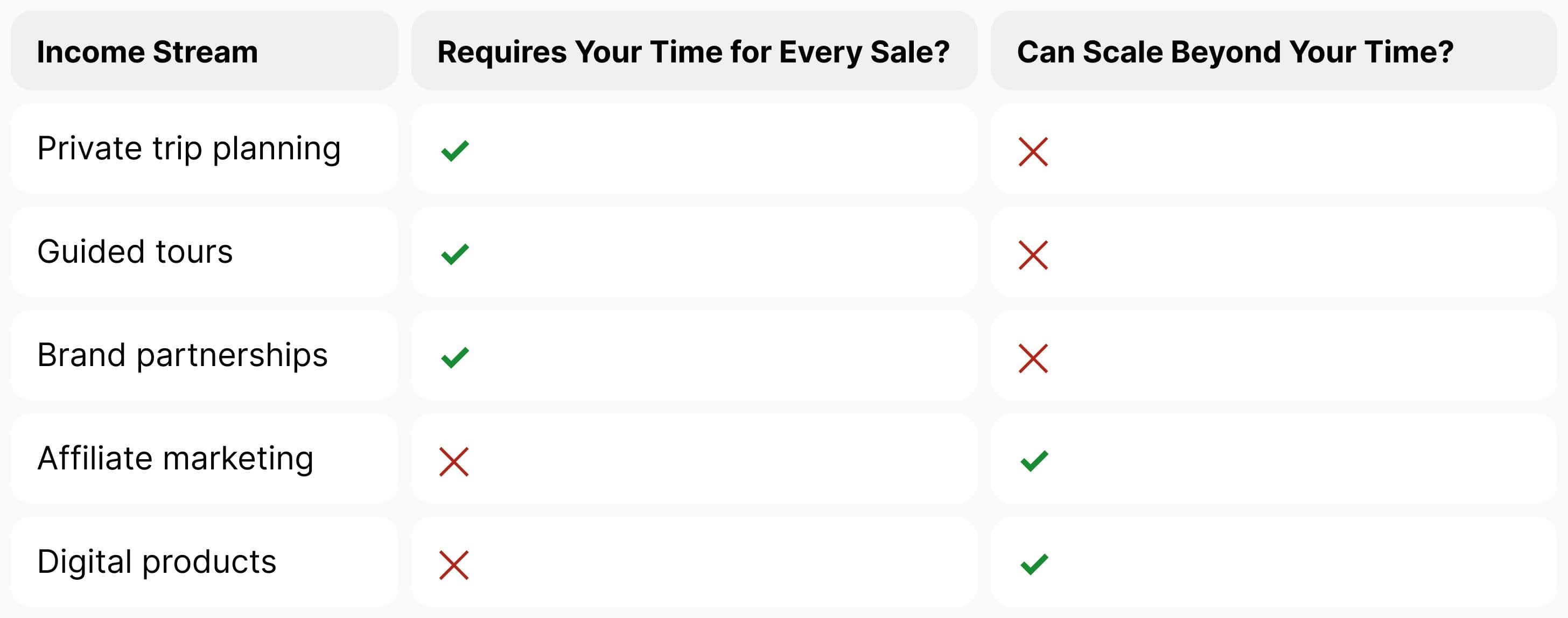
For example, a travel blogger might spend an hour helping a client plan a trip, for which they would be paid. The next client might require another hour of work.
Digital products follow a different model. Once created, it can be purchased by multiple travellers, meaning the process doesn't have to be started from scratch each time. While it still benefits from regular updates and improvements, the core work doesn't have to be repeated for every customer.
This is why many experienced creators don't replace active income; they complement it with products and revenue streams that continue to generate income in the background.
Build Multiple Income Streams
One of the biggest mistakes that travel creators can make is to rely on a single source of income. Every revenue stream comes with its own risks. Social media algorithms change, sponsorship opportunities vary from season to season, affiliate commission rates can fall, and even successful guided tours depend on availability and demand. The more your income relies on one channel, the more vulnerable your business becomes when that channel changes.
Diversifying your income doesn't mean doing everything at once. It means gradually building several revenue streams that support one another.
For example, a travel creator might combine:
- sponsored content for brand visibility;
- affiliate marketing for ongoing commissions;
- guided tours or travel planning services for premium, hands-on experiences;
- digital products that generate revenue throughout the year.
Each income stream plays a different role. Together, they create a more resilient business that's less dependent on any single platform, client or algorithm.
The objective is not to replace one income source with another. Rather, it's about building a portfolio of income streams that grows alongside your audience and your expertise.
Why Digital Products Change the Equation
Most monetisation methods depend on your continued participation. Every new client requires another consultation, every guided tour takes up another day of your time, and every sponsored campaign means creating another piece of content. While these income streams can be lucrative, they are naturally limited by how much time you have available.
Digital products follow a different model.
Rather than selling your time, you're selling knowledge that you've organised into something valuable for your audience. A travel itinerary, city guide or interactive travel guide can be purchased by multiple travellers, meaning you don't need to recreate the work for each customer.
However, that doesn't mean digital products are completely passive. They still need to be planned, improved and updated as destinations change or your expertise grows. The difference is that you're creating an asset that can generate value long after its creation.
For many travel creators, this becomes the first income stream that isn't directly tied to their calendar. Rather than replacing sponsorships, tours or consultancy work, digital products complement these activities and make the business as a whole more resilient

What Can Be a Digital Product?
There are many different types of digital product, and the best option for you will depend on your audience and the kind of travel content you produce.
Some creators sell travel itineraries, destination guides, restaurant collections, road trip guides, travel planning templates, and interactive travel guides. While these products may look different, they all serve the same purpose: they package your knowledge in a way that travellers can access whenever they need it, without you needing to be involved each time.
If you're looking for inspiration, check out our guide, Digital Products for Travel Creators: 10 Ideas to Sell Online, where we compare the most popular product types and explain which are best suited to different audiences.
Why Travel Guides Are One of the Easiest Products to Start With
When creating your first digital product, you don't have to start from scratch.
In fact, many travel creators already have most of the necessary content. Every itinerary you've planned, every restaurant you've recommended, every hidden spot you've revealed and every question you've answered has added to your valuable collection of travel knowledge.
A travel guide simply brings this knowledge together in a format that's easier for travellers to use — and easier for you to share or sell.
Unlike online courses or membership communities, travel guides don't require new teaching skills or the production of ongoing content. They build on the expertise you already have, making them one of the most accessible digital products for beginners.
Another advantage is that travel guides can evolve over time. As you discover new places, revisit destinations or receive feedback from travellers, you can update your recommendations without having to start again from scratch.
If you're ready to take the next step, our guide How to Sell Travel Guides Online explains how to package, price and launch your first travel guide.
How AI Makes Creating Digital Products Faster
One of the biggest challenges in creating digital products has always been time management.
Tasks such as organising notes, writing descriptions, structuring itineraries, editing content, and maintaining up-to-date information can take days or even weeks.
However, today, AI can dramatically speed up this process.
Rather than starting from scratch, creators can use AI to organise their ideas, draft descriptions, structure itineraries, and transform scattered notes into an initial, coherent version of a digital product. While the final product will still benefit from your personal experience and editing, much of the repetitive work will be quicker and easier.
For travel creators, this means spending less time formatting content and more time adding valuable insights and recommendations that make their guides stand out.
If you're interested in seeing how this works in practice, try the Octripus AI Copilot and transform your travel knowledge into an interactive travel guide. 👉 Chat with the AI Copilot
Common Challenges Travel Creators Face When Monetizing Their Knowledge
Many travel creators realise that their knowledge is valuable, yet still delay creating their first product or launching a new source of income.
More often than not, the problem is not a lack of experience, but rather a few common misconceptions.
Not all digital products are equally easy to maintain.
Some require complete reworking with every update, while others can be developed gradually by adding new recommendations, itineraries or useful information.
If you plan to develop your product over time, it’s worth choosing a format that’s easy to update and will remain user-friendly as your content grows.
Believing You Need a Huge Audience
You don't need hundreds of thousands of followers to start monetising your expertise. A smaller, highly engaged audience is often far more valuable than a large, disengaged one.
Waiting for the Perfect Product
Many creators delay launching their products because they want everything to be perfect.
In reality, however, your first product doesn't have to incorporate every recommendation you've ever received. It's better to launch something useful, gather feedback and then improve it over time.
Depending on a Single Income Stream
Relying solely on sponsorships or affiliate marketing can make your income unpredictable.
Creating multiple revenue streams makes your business more stable and gives you greater control over your earnings.
Underestimating the Value of Your Experience
The places you recommend, the itineraries you plan and the advice you give in your messages are all things travellers actively seek out.
What you consider to be ordinary may save someone hours of research and help them enjoy a much better trip.
Thinking You Have to Build Everything Yourself
These days, creating a digital product doesn't mean starting with a blank document.
Modern AI tools can help you organise your ideas, structure your content, and speed up the initial drafting process. This frees up time for you to add the personal insights that make your recommendations unique.
FAQ
Can you make money from travel content without a huge audience?
Yes. While a larger audience can create more opportunities, trust is more important than the number of followers. Many travel creators successfully sell digital products to a relatively small, but highly engaged, community. If your recommendations consistently help people to plan better trips, you can already offer them something of value that you can package and sell.
What is the easiest digital product for a travel creator to sell?
Interactive travel guides and itineraries are among the easiest products to start with, as most creators already have the necessary content. The recommendations you've shared via messages, saved maps, PDFs or social media posts can often form the basis of your first digital product.
Do I need technical skills to create a digital product?
No. Modern tools enable creators to develop guides, itineraries and downloadable resources without the need for coding or design expertise. AI can also help to organise your content, write descriptions and speed up the creation process.
Can I sell digital travel guides alongside affiliate marketing?
Absolutely. In fact, they work well together. A digital guide generates direct revenue from sales, and carefully selected affiliate links inside the guide can generate additional income when travellers book hotels, tours or other services.
What digital products generate passive income for travel creators?
Digital products such as travel guides, itineraries, destination packs, checklists, maps and templates can generate sales long after they are created. Although they require updates from time to time, they are far less dependent on your daily availability than consulting or guided tours.
How long does it take to create a digital travel guide?
It depends on how much content you already have. If you've been sharing recommendations with clients or your audience for years, then you've already done a lot of the work. AI-powered tools enable many creators to publish their first guide much faster than expected.
Conclusion
Turn Your Knowledge Into an Asset
Every travel creator has valuable knowledge. The difference is that some creators share their knowledge one conversation at a time, while others package it up into products that can be sold repeatedly.
Creating digital products doesn't mean giving up brand partnerships, affiliate marketing or guided tours. It means adding a revenue stream that isn't limited by your schedule and which continues to create value long after the work is finished.
You don't need a large following, specialist technical knowledge, or months of preparation to get started. The recommendations you share today could form the basis of your first digital product.
The sooner you start packaging up your expertise, the sooner your travel knowledge will start working for you — not just when you're online, but every day.
Ready to Create Your First Digital Travel Guide?
With Octripus, you can use AI to turn your travel knowledge into interactive digital guides in minutes. Rather than starting from scratch, you can organise your recommendations and enrich them with maps, tips, images and local insights to create a professional guide that travellers can actually use.
Create your first digital travel guide today and transform your experience into a valuable product.