Why are travel recommendations becoming a product?
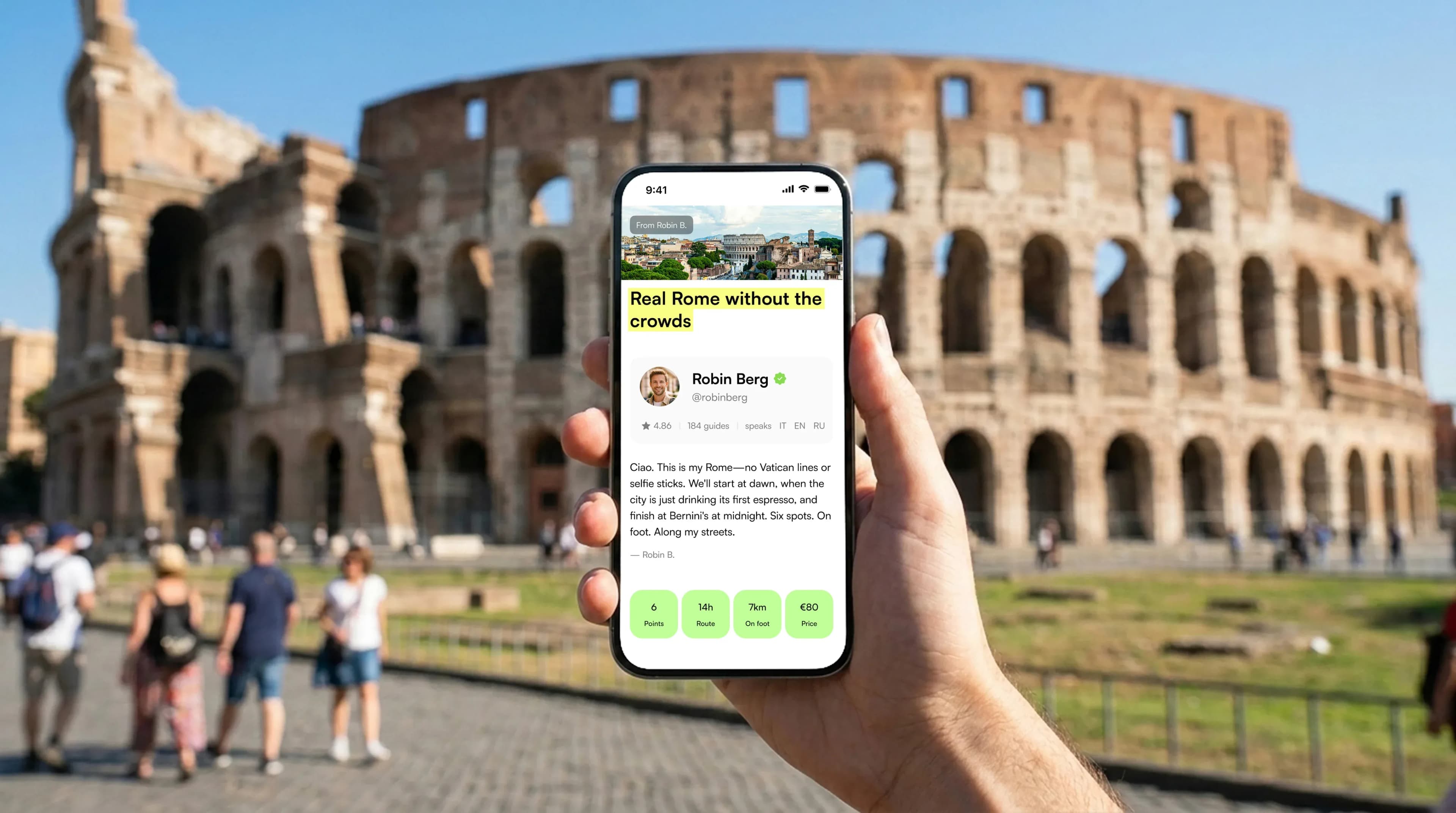
The way travel recommendations are created today is completely different to how it was just a few years ago.
People still send each other itineraries, share lists of places to visit and save locations on Google Maps, as well as compiling notes before a trip. However, the format in which this information is conveyed has hardly changed.
This is where the gap begins to emerge.
On the one hand, travel is becoming more knowledge-, experience- and expertise-based. On the other hand, much of this knowledge still exists in the form of messages, documents, links and manual explanations.
Meanwhile, the market itself is already moving in a different direction — towards more structured, reusable, product-oriented formats.
Previously perceived as recommendations or content, this information is gradually turning into a standalone product.
Why is it so difficult to share good itineraries with others?
If you look at how itineraries are created today, you will see that the process is almost the same for everyone.
Information is gathered piecemeal from various sources: saved locations in Google Maps, notes on your phone, bookmarks, screenshots, voice messages and chat histories. Over time, these sources of information turn into a personal knowledge base — sometimes more structured, sometimes less, but generally functional.
This is how travel guides, content creators, local experts and independent travellers work.
The problem arises later, when it comes to using and sharing the information.
When you need to compile all this information into a coherent itinerary, send it to someone else or reuse it, the manual work begins. The information is scattered, the logic is unclear and the context is lost. Most of the structure only exists in the author’s mind.
Virtually every travel creator faces the same situation: valuable recommendations exist for years in the form of messages that have to be explained, reassembled or adapted all over again for each new person.
As a result, a significant portion of this value never becomes a fully-fledged product.
Knowledge can either be 'handed out' through communication, or it requires dedicated time, manual assembly and constant maintenance to be packaged up.
Itineraries are created as a product, but continue to exist as a communication process.
Ultimately, users receive not a ready-made solution, but a set of explanations, links and context.
Although this format has long been the norm, it is precisely this that is beginning to limit the scalability, reusability and monetisation of the travel experience.
How travel information is handled today
The problem isn’t a lack of tools; rather, there are now so many that users are forced to link them together themselves.
Maps are used to save locations.
Documents and note-taking services are used for notes.
Editors and presentation tools are used for visual design. Messengers and email are used for communication.
Each of these tools performs its specific function well. However, itineraries continue to exist as a collection of disparate elements that users are forced to piece together manually.
Information constantly shifts between different formats:
In the process, the structure, context and logic of the itinerary itself are lost.
This is precisely why even experienced travel creators, guides or agencies often work not with a ready-made product, but with the constant manual compilation of information for each new enquiry.
The problem is not a lack of tools.
The problem is that the final result still has to be compiled manually.
What is changing, and why does it matter?
These changes are taking place against the backdrop of a broader shift in how knowledge is created, shared, and monetised.
In recent years, the creator economy has evolved into a well-established market with its own infrastructure, platforms, and monetisation tools. According to SignalFire, over 50 million people worldwide now consider themselves to be creators. However, the most significant development is not just the size of the market, but also the fact that individuals are increasingly monetising not only their content, but also their expertise, experience, and knowledge.
This is particularly noticeable in the travel industry.
Recommendations, itineraries, local guides and travel scenarios are no longer just a way of communicating with an audience; they are becoming valuable in their own right. Instead, they are increasingly being perceived as valuable assets that can be reused, packaged and monetised.
At the same time, travellers' behaviour is changing too.
Nowadays, most trips are planned independently, and social platforms have become one of the main sources of inspiration. According to Expedia, over 60% of users look for travel inspiration on social media, and creators' recommendations directly influence their decisions.
At the same time, user expectations are changing.
People are becoming less interested in receiving a random assortment of links, posts and tips. Instead, they expect a more structured, understandable and ready-to-use experience.
In parallel, the infrastructure for digital products is developing. Creating, distributing and monetising knowledge-based products is easier than ever. The clear barrier that used to exist between 'sharing experience' and 'creating a product' is gradually disappearing.
The 'tips in posts' format is still effective.
However, it is becoming increasingly out of step with the level of value already being created in the market.
The same scenario repeats itself over and over
The process itself almost always looks the same, whether we’re talking about a guide, a travel creator or an independent traveller.
Information gradually accumulates in the form of saved places, notes, links, routes, recommendations and local itineraries.
Over time, this turns into a valuable body of knowledge and experience, but more often than not, it remains fragmented: scattered across messages, documents, maps and personal notes.
When a new request arises, all this information must be translated into communication again — it has to be explained, reassembled, adapted and passed on manually.
Almost from scratch every time.
The problem here is neither a lack of information nor a lack of tools.
The problem is that accumulated knowledge rarely becomes a standalone product.
It remains a process, not a result.
This is precisely why even a vast amount of experience does not always translate into a scalable, reusable format.

Where the market is heading
The market is gradually shifting in a different direction.
Whereas the task used to be simply to convey information, there is now an increasing demand for a format that can be used without further explanation.
We are seeing:
- more structured itineraries;
- professionally designed travel guides;
- solutions that reduce the need for manual communication;
- tools that enhance the travel experience.
However, the main change is happening at a deeper level.
The very logic of the market is changing.
It is no longer about conveying information, but about providing ready-made solutions.
Communication is no longer the final format.
For a long time, travel existed as an information market. It is now gradually beginning to transform into a market for knowledge-based products.
A new layer of solutions is emerging
Against this backdrop, a new category of products is emerging.
While existing tools deal with individual stages, such as gathering, storing or formatting information, the focus here shifts to the result.
These solutions:
- bring together disparate processes
- structure knowledge
- transform it into a standalone product
Not just information
But a format that can be used straight away.
It is still difficult to say that this category has been fully established. However, the trend itself is already quite clear:
Moving from working with information → to working with knowledge-based products
Perhaps this is precisely where the next segment of the travel market is beginning to emerge.
What does this change?
This shift not only changes the format, but also the market economy.
Guides will no longer have to repeat the same work over and over again.
Creators gain the opportunity to monetise knowledge as well as attention.
Businesses will no longer be able to sell documents disguised as products.
Most importantly, users stop receiving explanations.
They start receiving a ready-made solution.
This transition involves moving from a service to a product and from manual labour to a scalable result. This is precisely why we are not just talking about a new content format, but a potential change in the entire logic of interacting with the travel experience.
This is how it is already playing out in practice.
Such approaches are already appearing in real-world products.
It is precisely at this intersection that new solutions are emerging.
One example is Octripus. This platform transforms scattered travel information, such as links, notes and saved locations, into structured itineraries with clear logic.
Rather than receiving a disorganised collection of information, users receive a format that can be used without further explanation, shared with others and reused.
Shared. Reused. Scaled.
The process remains the same.
But the result changes.
Where is all this heading?
The market is currently at a turning point.
The old format, based on communication, still works.
However, the new format, which is product-based, is only just beginning to take shape.
But the direction is already becoming clear:
from knowledge transfer → to packaging it into a product
This is no longer a question of 'if'.
The question now is how quickly this will become the new norm.